
Ai Consultancy provides a solution focused, professional and personalised service.
© Copyright Ai Consultancy (Aust). 2026.
All Rights Reserved. Created by Codex Digital.

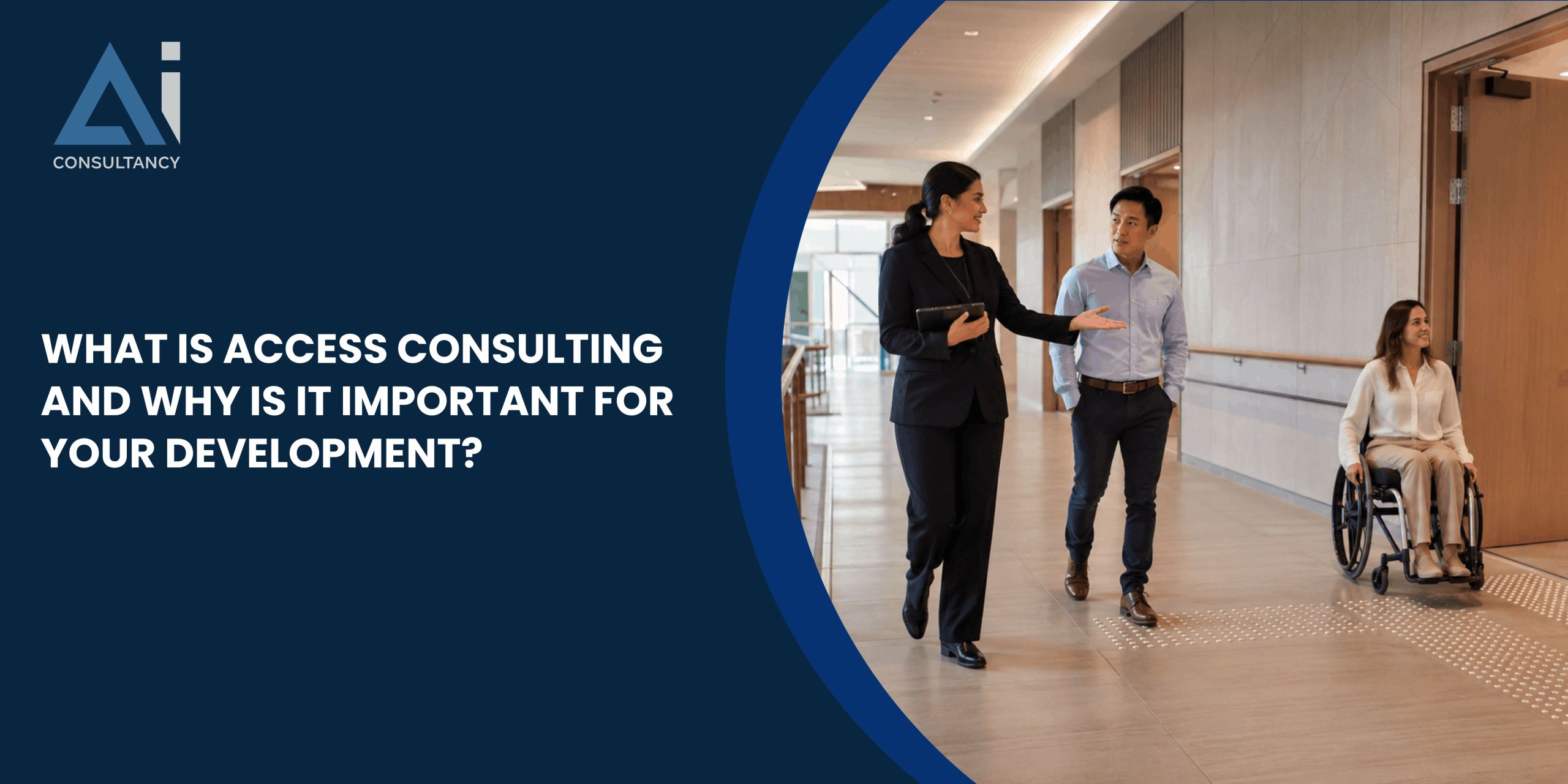
More than 4.4 million Australians live with disability. For architects, developers, and certifiers, that number represents real people who need to use the buildings being designed and built. Accessibility is not incidental to the design process. It is part of it.
Access consulting provides the specialist knowledge needed to make buildings work for people with disability, address legal requirements, and reduce the risk of compliance problems emerging later in the project.
This article explains what access consulting is, how it applies to a building project, and why it matters for development in New South Wales.
Access consulting provides specialist advice on accessibility requirements for buildings and the built environment. An access consultant assesses whether a building’s design or existing conditions meet the relevant legislative and technical standards that apply to people with disability.
In Australia, those requirements come from several sources: the Disability Discrimination Act 1992 (DDA), the Disability (Access to Premises — Buildings) Standards 2010 (Premises Standards), the National Construction Code (NCC), and Australian Standards such as AS 1428. Access consulting brings those sources together and applies them to the specifics of a project.
The work can cover a wide range of building types. Offices, retail premises, residential apartments, hotels, health facilities, educational buildings, and public infrastructure all carry accessibility obligations. The scope and complexity of access consulting will depend on the building, its use, and the stage of the project.
Accessibility obligations in Australia come from legislation, building standards, and technical requirements that work together. Understanding the framework helps developers and architects identify which obligations apply to their project.
| Instrument | What It Does |
|---|---|
| Disability Discrimination Act 1992 (DDA) | Federal legislation that prohibits discrimination against people with disability in access to premises, goods, and services |
| Disability (Access to Premises — Buildings) Standards 2010 | Technical standards made under the DDA that set out specific access requirements for new buildings and certain upgrades |
| National Construction Code (NCC) | Adopts the Premises Standards and sets out technical requirements for accessibility in new buildings and some existing buildings undergoing work |
| AS 1428 series | Australian Standards that provide detailed technical requirements for accessible design, referenced by the NCC |
Compliance with the NCC and Premises Standards provides a defence against DDA complaints in relation to the matters covered by those standards. However, the DDA applies more broadly. An access consultant can advise on both sets of obligations and how they interact with the design.
Access consulting is relevant wherever a building or proposed development carries accessibility obligations. In practice, this covers most commercial and multi-residential developments. The people who typically need access consulting advice include:
To check whether the proposed design addresses the applicable accessibility requirements and identify issues while the design can still be adjusted.
To understand accessibility obligations before committing to a project and reduce the risk of compliance issues arising after development approval or during construction.
To understand accessibility issues in an existing building, particularly when planning refurbishment, a change of use, or a property transaction.
To obtain specialist input on complex accessibility matters that may arise during the assessment of development applications or construction certificates.
To plan accessibility upgrades, understand current compliance obligations, and manage the risk of DDA complaints.
To address accessibility obligations across public buildings, infrastructure, and facilities, and meet obligations under disability inclusion legislation.
The scope of an access consultant’s work depends on the project type and stage. Common services include:
Within each of those services, the focus is practical: identifying what the requirements are, assessing whether the design or building meets them, and advising on how to address any gaps. The specifics will vary depending on the building type, its classification, and the relevant obligations that apply.
For a new commercial building, access consulting during the design stage will typically review the accessible path from the street or carpark, the main entrance, internal circulation, sanitary facilities, and other relevant elements. For an existing building being refurbished, the starting point is an audit of current conditions before any work on the proposed changes begins.
An access design review can identify accessibility issues while the design still has flexibility to address them.
Review Your Design →Access consulting and BCA consulting are related but distinct. Both address building compliance requirements, and both may be needed on the same project. The difference is in focus.
| Access Consulting | BCA Consulting |
|---|---|
| Focuses on accessibility requirements under the DDA, Premises Standards, NCC, and AS 1428 | Focuses on broader NCC compliance, including fire safety, structural requirements, and building services |
| Assesses whether buildings work for people with disability | Assesses whether buildings meet safety and technical standards |
| Considers both legal obligations and the practical usability of the building | Primarily considers technical compliance with code provisions |
| May include advice on DDA obligations beyond the NCC | Is generally limited to the NCC and relevant referenced standards |
On most commercial developments, both consultants will be engaged. The BCA consultant covers overall code compliance while the access consultant gives detailed attention to the accessibility elements. On smaller or simpler projects, the two roles are sometimes combined.
The earlier an access consultant is involved, the more flexibility there is to address findings within the design. Engaging access consulting at each relevant stage provides the project team with the right information at the right time.
When accessibility is not addressed properly during design, the consequences can emerge at different points in the project lifecycle. Common problems include:
In each case, the cost of addressing the problem increases the later it is identified. A design change before documentation is complete is a far simpler undertaking than a rectification after construction. Engaging access consulting at the right stage of a project is one of the more straightforward ways to reduce these risks.
Access consulting provides specialist advice on accessibility requirements for buildings. It draws on the DDA, Premises Standards, NCC, and Australian Standards to assess whether a design or existing building meets its obligations and identify what needs to change.
The right time to engage an access consultant depends on the project stage. Early involvement during design gives the most flexibility. For existing buildings, an audit before refurbishment or a property transaction provides a clearer picture of current conditions. Getting access consulting right at each stage reduces the likelihood of more significant problems later.
Find out how access consulting applies to your project and what accessibility requirements you need to address at each stage.
Discuss Your Project →An access consultant assesses whether a building’s design or existing conditions meet relevant accessibility requirements under the DDA, Premises Standards, NCC, and Australian Standards. The work can include design reviews, accessibility audits, access reports for development applications, performance solutions, and construction-stage inspections.
The legal requirement is to comply with accessibility requirements under the DDA, Premises Standards, and NCC — not to engage an access consultant specifically. However, access consulting provides the specialist knowledge needed to demonstrate compliance and reduce the risk of accessibility issues arising during approvals, construction, or occupation.
The DDA is federal legislation that prohibits disability discrimination in access to premises, goods, and services. The NCC sets out technical requirements for building design and construction, including accessibility provisions drawn from the Premises Standards. Compliance with the NCC provides a defence against DDA complaints in relation to covered matters, but the DDA applies more broadly than the NCC.
Early engagement during design development provides the most flexibility to address accessibility findings. Access consulting can also be relevant before a property transaction (access due diligence), before lodging a development application, during construction, and for existing buildings being refurbished or assessed.
It depends on the project. On most commercial developments, both consultants are engaged — the BCA consultant covers broader NCC compliance while the access consultant focuses on accessibility. On some smaller or simpler projects, the roles may be combined. An access consultant can advise on what is appropriate for your project.
Ai Consultancy provides a solution focused, professional and personalised service.
© Copyright Ai Consultancy (Aust). 2026.
All Rights Reserved. Created by Codex Digital.
