
Ai Consultancy provides a solution focused, professional and personalised service.
© Copyright Ai Consultancy (Aust). 2026.
All Rights Reserved. Created by Codex Digital.

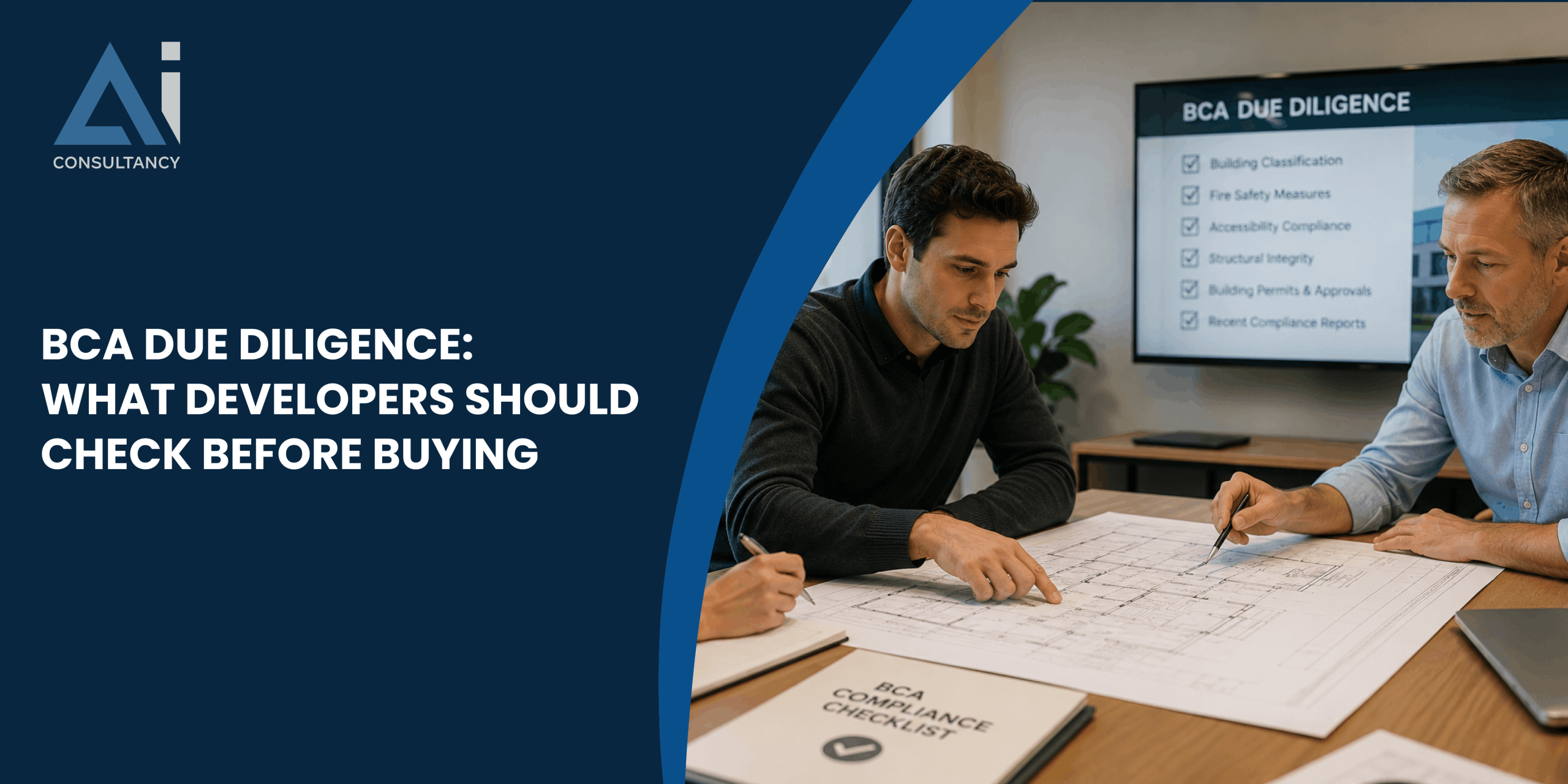
KPMG estimates that construction defects cost the Australian economy $6 billion annually. Many of those defects trace back to compliance problems that were either not identified or not properly addressed during development. For a developer acquiring an existing building or site with structures on it, BCA due diligence is the tool that surfaces those problems before the purchase is finalised.
Discovering a significant BCA compliance issue after settlement gives you far fewer options than discovering it before. The cost of addressing a fire safety upgrade, an inaccessible entry, or a structural non-compliance shifts from a negotiating point to a project liability the moment contracts are exchanged.
This article explains what BCA due diligence involves, what developers should look for, and how the assessment fits into a property acquisition.
BCA due diligence is an assessment of a property’s existing compliance position under the Building Code of Australia (BCA) and the National Construction Code (NCC). It reviews the building as it currently exists, considers the documentation available, and identifies potential compliance risks relevant to the proposed acquisition or development.
The assessment is not a building inspection in the traditional sense. It does not focus on maintenance issues, material condition, or defects in the way a building inspection report does. BCA due diligence addresses a different question: does this building have compliance problems that could affect what you want to do with it, and if so, what are they likely to involve?
The scope of a BCA due diligence assessment will vary depending on the building, its age, the available documentation, and the developer’s intended use. For a simple acquisition of a single-tenancy building with a clear approval history, the review may be relatively straightforward. For a mixed-use building with incomplete records, multiple past alterations, or a proposed change of use, it will be more involved.
A BCA due diligence assessment considers the building as it stands and the documentation available for it. The areas typically covered include:
Whether the current use and any proposed use align with the correct NCC classification, and what changes in classification would require.
Whether the existing fire safety provisions are consistent with the building’s current use, classification, and approval history — including fire separation, exits, and installed systems.
Whether the building provides the required access for its current use, and what accessibility obligations may arise from a proposed change of use or refurbishment.
Whether the available approvals, certificates, and documentation are consistent with the building as it exists, and whether any gaps or inconsistencies are apparent.
Whether previous work appears to have been carried out with appropriate approvals and whether those alterations create any compliance concerns relevant to the proposed development.
Whether the building’s existing compliance position creates constraints on the proposed development strategy, and what those constraints might involve.
Fire safety is one of the most significant compliance considerations for existing buildings. Older buildings may have fire safety provisions that reflect the code requirements at the time of their construction. When a building is altered, extended, or changes its use, the applicable requirements can change, and additional fire safety work may be required.
For a developer, this matters for two reasons. First, there may be existing fire safety deficiencies in the building that will need to be addressed regardless of what development work is proposed. Second, the proposed development itself may trigger additional fire safety requirements that add cost and complexity to the project.
BCA due diligence can identify both of these issues before the purchase is confirmed. Knowing that a fire safety upgrade is likely to be required, and having some sense of its scope, allows the developer to factor that cost into their feasibility analysis and negotiate accordingly.
Accessibility requirements are closely linked to building classification and use. A building that currently meets its accessibility obligations under its existing use may not meet those obligations once the use changes. For example, a building used as a warehouse that a developer proposes to convert to offices or retail will face a different set of accessibility requirements as part of that conversion.
The Disability (Access to Premises — Buildings) Standards 2010 and the NCC set out when accessibility upgrades are required in connection with building work on existing buildings. BCA due diligence can identify whether a proposed development is likely to trigger those requirements and what they are likely to involve for the particular building.
Accessibility constraints can affect layout options, lift requirements, amenity provisions, and the cost and complexity of a proposed development. Identifying them before the purchase allows the developer to plan for them rather than discovering them during design or construction.
BCA due diligence identifies compliance risks and development constraints before the purchase is finalised, when you still have options.
Request a Due Diligence Assessment →The quality and completeness of a building’s documentation has a direct bearing on what a BCA due diligence assessment can establish. Where records are complete, the assessment can confirm approvals, identify any gaps between the approved and as-built condition, and give a clearer picture of the building’s compliance history.
Where documentation is incomplete or absent, the assessment can identify what is missing and what the implications of those gaps might be. The documentation typically sought for a BCA due diligence assessment includes:
A seller who cannot produce key documents is not necessarily concealing a problem, but missing documentation does create uncertainty about the building’s compliance history. BCA due diligence helps the developer understand the significance of that uncertainty before making a commitment.
A developer’s intended use for a property shapes what compliance requirements will apply to any development work. The proposed use determines the building classification, which in turn determines the applicable NCC provisions for fire safety, accessibility, and other matters.
Some development strategies are more affected by a building’s existing compliance position than others. A developer proposing to retain the existing building and change its use will need to address compliance requirements associated with both the existing building and the proposed change. A developer proposing to demolish and rebuild will face a different set of considerations.
BCA due diligence is most useful when it is framed around the developer’s actual intentions for the property. An assessment that considers the proposed development strategy, not just the building’s current state, can give the developer a more useful picture of what BCA compliance will involve for the project they have in mind.
BCA due diligence is most useful before a commitment is made. Once contracts are exchanged, the options for using compliance findings to negotiate price, renegotiate terms, or walk away from the transaction are significantly reduced.
A BCA due diligence report gives the developer a documented summary of the building’s compliance position based on the available information. It is not a guarantee of compliance, and it does not replace the detailed BCA assessment that will be required as part of any subsequent development. What it provides is a clearer picture of where compliance risks exist and what those risks are likely to involve.
| What the Report Covers | What It Helps the Developer Do |
|---|---|
| Existing compliance position | Understand the building’s current BCA status before committing to the purchase |
| Identified compliance risks | Factor the cost and complexity of compliance work into the feasibility analysis |
| Documentation gaps | Identify where further investigation or information is needed before proceeding |
| Development strategy implications | Understand how the proposed development will interact with the existing building’s compliance position |
| Issues requiring specialist input | Identify where fire engineering, access consulting, or other specialist assessments are needed |
BCA due diligence gives developers a clearer picture of a property’s existing compliance position before a purchase is finalised. Fire safety, accessibility, documentation gaps, and the interaction between the existing building and the proposed development strategy are all relevant considerations.
The value of a BCA due diligence assessment lies in timing. Findings identified before contracts are exchanged can be used to negotiate, to plan, or to decide not to proceed. The same findings identified after settlement become project liabilities that have to be managed at the developer’s cost.
Understand the compliance position of a property before committing, while you still have the ability to negotiate, plan, or walk away.
Request an Assessment →BCA due diligence is an assessment of a property’s existing compliance position under the Building Code of Australia and National Construction Code. It reviews the building’s current state, available documentation, and approval history to identify compliance risks relevant to a proposed acquisition or development.
No. A building inspection assesses the physical condition and maintenance of a property. BCA due diligence addresses compliance with the Building Code of Australia and NCC — including fire safety, accessibility, classification, and approval history. Both may be relevant to a property acquisition, but they answer different questions.
BCA due diligence is most useful before contracts are exchanged, when findings can still be used to negotiate, plan, or reconsider the acquisition. It fits within the due diligence period alongside legal, financial, and planning investigations. For complex properties, a preliminary assessment before making an offer may also be worthwhile.
Common findings include fire safety provisions that may require upgrading, accessibility constraints associated with a proposed change of use, gaps in the building’s approval documentation, previous alterations that raise compliance questions, and development strategy implications arising from the building’s existing compliance position.
No. BCA due diligence provides an assessment of the building’s compliance position based on available information. It identifies risks and areas of concern but does not constitute a certification of compliance. A detailed BCA assessment will still be required as part of any subsequent development or approval process.
Ai Consultancy provides a solution focused, professional and personalised service.
© Copyright Ai Consultancy (Aust). 2026.
All Rights Reserved. Created by Codex Digital.
