
Ai Consultancy provides a solution focused, professional and personalised service.
© Copyright Ai Consultancy (Aust). 2026.
All Rights Reserved. Created by Codex Digital.

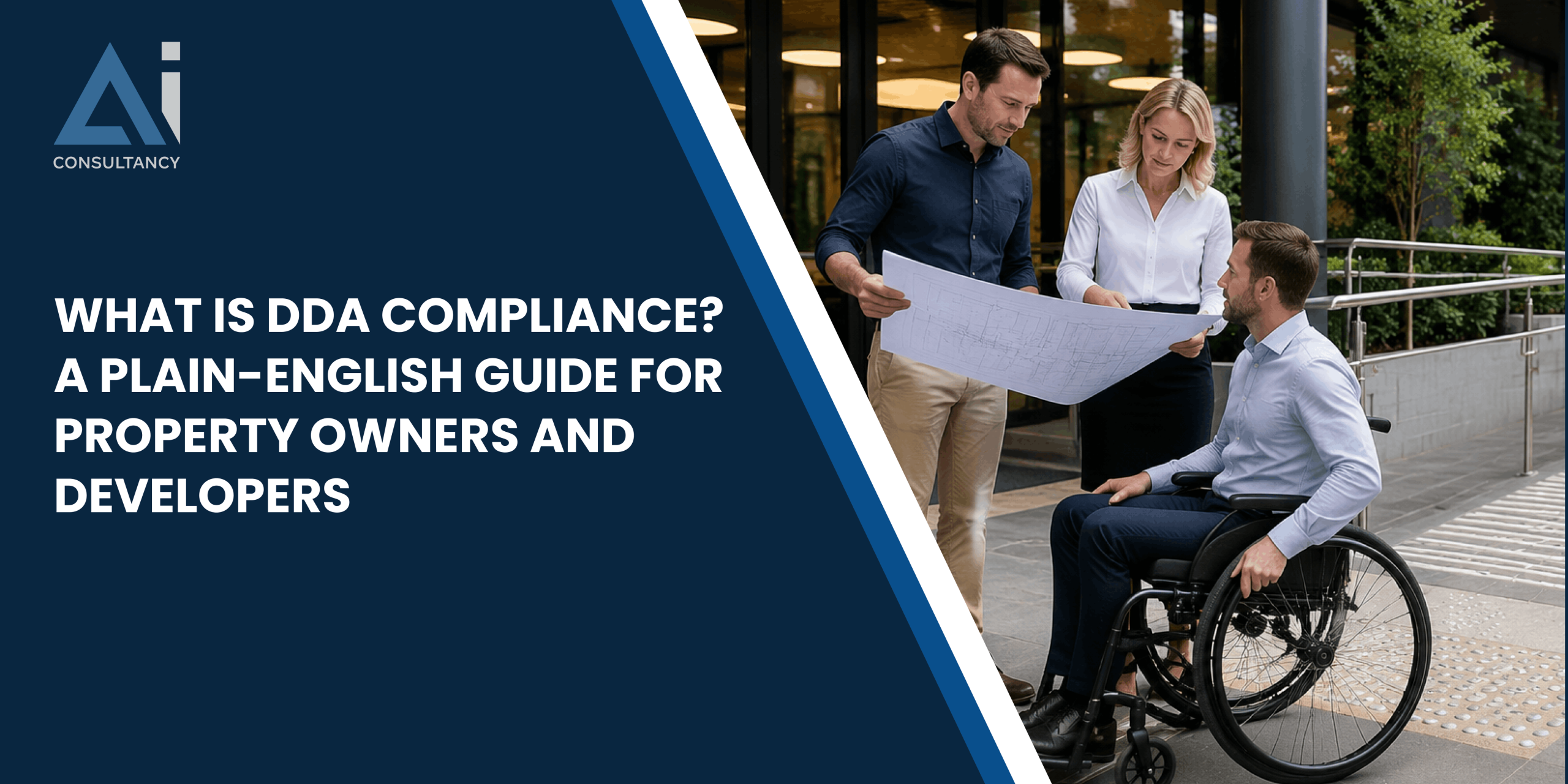
A 2024 study shows almost 1 in 5 Australians has a disability. For most building users, accessibility is a critical design consideration. For people aged 65 and over, the rate is 1 in 2.
These numbers show that accessibility is a functional need for inclusive building design, not just a legal obligation.
There are several regulations to guide designers and builders on how to ensure accessibility in a building. Property owners and developers must meet several overlapping requirements to achieve Disability Discrimination Act (DDA) compliance:
Project teams can harmonise accessibility into the design before documentation, approvals, or construction progress by identifying applicable requirements early.
DDA compliance ensures buildings in Australia are accessible and non-discriminatory for people with disabilities. This blog explains what DDA compliance means, the legal requirements for property owners and developers, and how to meet them during design and construction.
DDA compliance in Australia generally refers to providing access to premises without unlawful discrimination against people with disabilities.
The legal framework starts with the Disability Discrimination Act 1992 (DDA). For applicable buildings and building work, the Disability (Access to Premises – Buildings) Standards 2010, commonly called the Premises Standards, provide specific requirements for access.
The government has created the Premises Standards under the DDA. These standards provide dignified and equitable access to buildings and give building certifiers, developers, and managers greater certainty about their responsibilities.
For a building project, disability access compliance may also require considering the NCC and Australian Standards referenced in the applicable provisions.
The Disability Discrimination Act 1992 is Commonwealth legislation that protects people against discrimination based on disability across areas of public life.
Section 23 deals specifically with access to premises and makes disability discrimination unlawful in certain circumstances involving access to or use of premises.
The DDA establishes the legal obligation, while more detailed building accessibility requirements are provided through the Premises Standards, NCC and referenced technical standards.
For developers and property owners, these requirements influence decisions about entrances, paths of travel, amenities, parking, vertical circulation, and other building parts.
The Disability (Access to Premises – Buildings) Standards 2010 are legally enforceable standards made under the DDA.
They contain the Access Code for Buildings, which establishes accessibility requirements for specified buildings and building work. The Standards also identify responsibilities applying to building certifiers, developers and managers.
New building approvals and certain upgrades to existing buildings can trigger the Premises Standards. The building type and proposed work determine the exact application.
This is why broadly referring to DDA building requirements can be misleading. Projects may need to evaluate several parts of Australia’s accessibility framework.
For project teams, their roles can be understood as follows:
| Framework | Role |
|---|---|
| Disability Discrimination Act 1992 | Establishes protection against disability discrimination, including access to premises |
| Premises Standards | Establish building accessibility requirements for applicable buildings and building work |
| National Construction Code | Contains corresponding technical access requirements within the building regulatory framework |
| Australian Standards | Provide detailed technical specifications referenced by the applicable requirements |
The NCC’s access provisions and the Premises Standards align closely, providing consistency between building approval and non-discriminatory access requirements.
In practice, a developer planning a new commercial building must determine the building classification, accessible areas, applicable NCC provisions, and technical requirements from referenced standards early.
Accessibility requirements affect much more than ramps and accessible toilets.
Depending on the building classification and use, DDA building requirements and related NCC provisions may affect:
NCC Part D4 contains Deemed-to-Satisfy provisions dealing with access for people with disability, including accessible areas, car parking, signage, hearing augmentation and tactile indicators.
Building classification and area determine the extent of required access. Design teams should plan and integrate accessibility features early, rather than adding them as individual elements late in the process.
Review accessibility requirements early to identify barriers, ensure access compliance, and reduce design changes.
Review Your Project →Existing buildings require more careful review than a simple yes or no.
The DDA is still relevant to access to premises, while the Premises Standards apply depending on the circumstances and building work.
Applications for approval of upgrades to existing buildings can trigger requirements under the Premises Standards.
For a property owner planning alterations or refurbishment, the key question is: What accessibility requirements apply to this building and the proposed works?
Establishing this early clarifies the access upgrades needed.
Auditors evaluate an existing property to identify accessibility barriers and review areas against requirements.
Depending on the building and purpose of the audit, the review may cover:
Owners and asset managers gain a clearer picture of access issues and can better prioritise upgrades or refurbishment planning by commissioning an audit.
Learn more about AI Consultancy’s Access Audits for Existing Buildings →
The NCC and Premises Standards contain technical accessibility provisions that closely align, providing consistency between building approval and non-discriminatory access requirements.
However, the DDA has a more extensive anti-discrimination function.
The Premises Standards themselves provide certainty in relation to DDA obligations to the extent that the Standards cover those matters.
For property owners and developers, NCC accessibility compliance and DDA compliance should not be treated as interchangeable. The building’s circumstances, use, and proposed work also matter.
AS 1428.1, Design for access and mobility, is one of the key Australian Standards used for accessible building design.
It contains technical requirements affecting elements such as accessible paths, circulation spaces, doorways, ramps and stairs.
There has been a recent regulatory update relevant to current projects. Following amendments to the Premises Standards and NCC 2022 Amendment 2, AS 1428.1:2021 is the referenced edition.
[For NSW projects: NCC 2022 Amendment 2 remains the current applicable edition in 2026. The NSW government has announced that NCC 2025 will commence on 1 May 2027.]
Project teams should check project documentation against the edition referenced by applicable regulations, not specifications from earlier projects.
Other Australian Standards may also apply depending on the building and accessibility aspects being assessed.
We can easily plan and integrate accessibility features when layouts, levels, and circulation arrangements can still be changed.
Here are some cases:
If you are a property owner or developer seeking practical support with accessibility, our DDA Access Consulting service can help you understand your obligations and achieve compliance.
The appropriate next step depends on the project:
| Project Situation | Recommended Starting Point |
|---|---|
| New development | Review accessibility requirements during design |
| Alterations or additions | Determine the requirements applying to the proposed work |
| Existing property | Consider an access audit to identify barriers |
| Accessibility constraint in the design | Obtain specialist advice before finalising a solution |
| Project approaching approval | Confirm accessibility documentation addresses applicable requirements |
The objective is to define applicable prerequisites early enough to coordinate them with the building design.
Get specialist access advice to identify requirements and coordinate practical accessibility provisions while your project can still adapt.
Discuss Your Project →DDA compliance means providing building access without unlawful disability discrimination, following the Disability Discrimination Act, Premises Standards, and relevant building codes. Property owners must ensure legal accessibility for people with disabilities in new and existing premises across Australia.
The Disability (Access to Premises – Buildings) Standards 2010 are legally enforceable standards made under the DDA. They establish accessibility requirements for specified buildings and building work and contain the Access Code for Buildings.
The DDA applies to existing buildings regarding access for people with disabilities. Whether the Premises Standards apply depends on the type of building, the nature of upgrades, and proposed alterations, making careful review essential for property owners planning changes.
AS 1428.1:2021 is Australia’s main standard for accessible building design, referenced by the Premises Standards and National Construction Code. It sets technical requirements for access and mobility, guiding designers to comply with DDA and ensure building accessibility.
Ai Consultancy provides a solution focused, professional and personalised service.
© Copyright Ai Consultancy (Aust). 2026.
All Rights Reserved. Created by Codex Digital.
